
How Your Brand Personality Shines Through on Your Website
7 min read
Brand Strategy Part 5 of 8
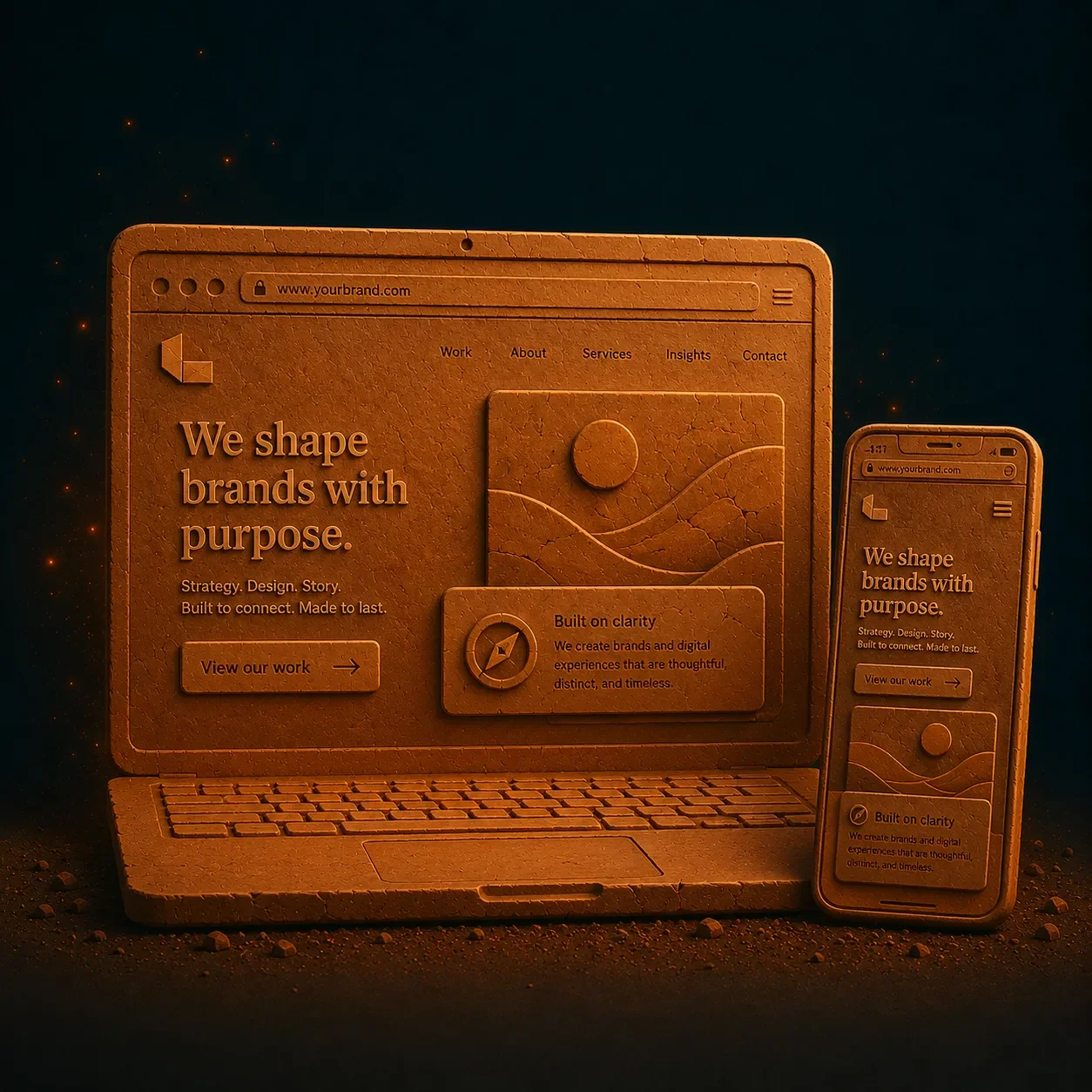
A brand's personality does not only live in its logo, its social media captions, or its advertising.
It also lives on the website.
That may sound obvious, but it is easy to forget. Over the last decade, social media has become the louder, faster, more expressive space for brands. It is where brands joke, respond, trend, launch, explain, tease, and sometimes lose their minds in the comments.
Websites, by comparison, have become more functional. They need to load quickly, work on mobile, answer questions, guide users, convert leads, sell products, take bookings, process payments, support search visibility, and help people trust the business.
In other words, the website has a job to do.
But that does not mean it should become personality-free.
If social media is where your brand performs in public, your website is where people come to understand whether the performance is backed by something real.
The website is not dead. Its role has changed.
It is tempting to think that social media has taken over everything. For some brands, especially those built around entertainment, culture, fashion, food, travel, sport, or lifestyle, a lot of the visible personality now happens on platforms like Instagram, TikTok, LinkedIn, YouTube, Facebook, and X.
That makes sense. Social platforms are dynamic. They reward timing, interaction, and ongoing participation. They give brands space to react, test ideas, build community, and show personality in public.
But that does not make the website irrelevant.
Globally, internet use continues to grow, with DataReportal reporting that internet users passed the 6 billion mark in 2026. In South Africa specifically, DataReportal reported 51.7 million internet users at the end of 2025, with internet penetration at 79.6%, and 29.1 million social media user identities, equal to 44.9% of the population.
Those numbers tell us something useful: people are deeply active online, but not every online interaction happens inside a social feed.
The website still has a specific role. It is often where people go when they want more certainty. They want to check the offer, compare products, read the detail, make contact, understand the business, browse services, book, buy, apply, download, or decide whether the brand is legitimate.
Social media may create the spark. The website often has to carry the trust.
Personality cannot come at the cost of function
One of the useful points from our discussion was that websites have less room for pure creative freedom than they once did. In the Flash website era, brands often built strange, immersive, experimental online experiences. Some were brilliant. Many were impossible to use.
The modern web is different.
People expect websites to be fast, responsive, clear, secure, and easy to navigate. A beautiful site that loads slowly, breaks on mobile, hides the important information, or makes users work too hard will damage the brand, no matter how expressive it looks.
That is especially important because performance is part of personality. A brand that claims to be premium cannot have a clumsy website. A brand that claims to be simple cannot have confusing navigation. A brand that claims to be helpful cannot bury the contact button. These are not just design problems. They are credibility problems.
In the dialogue, this came through clearly: professionalism and trustworthiness are personality traits too, and a website has to earn them through the basics: speed, mobile behaviour, usability, clarity, and technical reliability.
The website does not need to be loud to express the brand. It needs to feel right.
Content is where personality often shows up first
For most brands, the easiest place to express personality on a website is through content, and not just blog posts or articles, but everything. The headline on the homepage. The way services are explained. The photography style, the product descriptions, the microcopy on buttons, the onboarding flow, the error message, the contact page, the FAQs. Even the way a brand handles an empty state or a confirmation screen says something about who it is.
This is where many websites lose the personality that appears so strongly on social media. A brand may sound sharp, warm, funny, bold, or highly distinctive on Instagram or LinkedIn, but then the website suddenly sounds generic: "We provide innovative solutions." "We are passionate about excellence." "We offer a wide range of services." Nothing is necessarily wrong. But nothing is memorable either.
If the website is the place where people go to take the brand seriously, then the language needs to carry the same personality as the rest of the brand. Not in a forced way, and not with jokes everywhere, but with the same clarity, tone, confidence, and point of view.
Apple shows what happens when website and product personality align
Apple is a useful example because the website feels like an extension of the product. The brand has a clear personality: minimal, premium, deliberate, restrained, and highly considered. That personality shows up through large product imagery, controlled copy, careful scrolling experiences, generous white space, and a sense that every detail has been designed with intention.
The website does not feel separate from the product. It feels like part of the same world.
For Apple, the product pages are not just information pages. They are brand experiences. They celebrate the product, slow the user down, and make the object feel desirable, precise, and important.
Most small businesses will not have Apple's budget, design team, or technical capability, and that is fine. The lesson is not "build like Apple". The lesson is to make the website behave like the brand. If your brand is simple, the website should be simple. If it is premium, the site should feel considered. If it is practical, it should be easy to use. If it is playful, there should be moments of lightness. Personality should shape the experience, not just decorate it.
Naked Insurance shows personality through product flow
Some websites are not just communication platforms. They are part of the product itself.
Naked Insurance is a good example. The brand uses its digital experience, including the quote flow and chatbot-style interaction, as part of how the brand feels. The promise is not only expressed in advertising. It is built into the way people actually interact with the service.
That matters because a brand personality becomes much stronger when it is experienced rather than just described. If an insurer says it is simple but the quote process is painful, the personality collapses. If a bank says it is accessible but the website feels confusing, the brand feels dishonest. If a design studio says it is strategic but its own website has no clear structure, the claim becomes harder to believe.
The product flow is part of the brand, and so are the forms, the buttons, the confirmation screens, and the emails that follow. Personality is not just what the homepage says. It is what the whole experience proves.
Nando's shows the challenge of moving social personality onto a website
Nando's is interesting because its brand personality is very strong, especially in advertising and social media. It is cheeky, topical, local, culturally aware, and confident. But that kind of personality is harder to translate onto a website.
A restaurant website still needs to do practical things. People may want to find a menu, order food, locate a store, read about ingredients, or check delivery options. The website has to work first.
Nando's came up in the discussion as an example of a brand whose website carries some personality through colour, content, tone, visuals, and food heritage, but perhaps has fewer "that is so Nando's" moments than the social or advertising work. That is the tension many brands face. The more functional a website needs to be, the more carefully personality has to be placed.
It may show up in the menu labels, the loading states, the empty cart message, the story pages, or the way the brand handles errors. It does not need to interrupt the user. It needs to enrich the experience. A website should not become a joke machine, but it should not feel like the brand disappeared either.
Red Bull shows the difference between content and experience
Red Bull is another useful case because the brand's personality is so vivid in the world: extreme sports, energy, risk, youth culture, athletes, movement, music, and spectacle. On social media, that world is easy to express. A clip of someone launching down a mountain immediately feels like Red Bull.
On the website, the challenge is different. Much of the experience naturally becomes structured around content grids, product information, events, athletes, articles, and video sections. That is useful, but it can start to feel like a media or sports website if the brand system does not work hard enough to hold it together.
This came up in the dialogue too: Red Bull's content may carry the personality, but the website experience itself can still feel quite functional or templated in places. That distinction matters, because content, design, interaction, and structure can all express personality, and the strongest websites use more than one of those at once.
Sometimes the best personality lives in campaign pages
It is also worth being fair to big brands. A corporate homepage is often not where the most expressive personality lives. Large brands need corporate websites for investors, careers, media, compliance, product information, sustainability, governance, and global navigation. Those pages often have to be functional above all else.
The more expressive work tends to happen elsewhere: campaign landing pages, product launches, event sites, limited-run experiences, or microsites. This came up in the discussion around brands like Heineken, Red Bull, Coca-Cola, Ferrari, and Apple. The main corporate website may feel controlled or even bland, while a product or campaign page carries far more personality.
This is useful for smaller businesses too. Not every page needs to carry the same intensity of character. Your contact page should probably be clear before it is clever. Your privacy policy does not need to sound like a campaign. Your homepage needs to orient people quickly. But campaign pages, product pages, case studies, landing pages, and onboarding flows can often carry much more brand character. The trick is knowing where personality helps, and where it gets in the way.
Websites and social media should not compete. They should connect.
The mistake is thinking of website and social media as rivals. They have different jobs.
Social media is often better for speed, visibility, participation, experimentation, culture, conversation, and ongoing brand presence. The website is usually better for depth, structure, credibility, search, conversion, ownership, and complete brand experience.
That distinction matters because brands do not fully control social platforms. Algorithms shift, organic reach changes, platforms rise and fall, audiences move, formats evolve, and accounts can be restricted. Trends disappear overnight. A website is one of the few digital spaces a brand actually owns, and while that does not make it more exciting than social media, it does make it important.
Adobe's 2026 AI and Digital Trends research focused heavily on customer experience, loyalty, and AI-enabled engagement, based on surveys of 3,000 executives and practitioners and 4,000 customers. That kind of research points to a broader reality: brands are not being judged on single channels anymore. They are judged across connected experiences.
A person may discover you on social media, search for you on Google, land on your website, check your work, read a case study, click through to Instagram, come back to the website, send a WhatsApp, and only then decide whether to buy. The personality needs to survive that whole journey.
How to make brand personality show up on a website
A useful way to assess a website is to ask where the personality is visible, where it is useful, and where it is missing.
Start with the basics: does the site load quickly, work well on mobile, and make clear what the brand does? Can people navigate it without effort? Does it feel credible? These are not exciting questions, but they matter because a site that fails on the fundamentals undermines everything built on top of it.
Then look at the personality. Does the homepage sound like the brand, or could it belong to anyone? Do the visuals match the personality? Does the copy carry a clear tone of voice? Do the product or service pages feel distinctive, or do they read like a template? Are the calls to action generic, or do they feel like the brand speaking? Do the small details carry personality without creating friction? Do the case studies, articles, or landing pages express a point of view?
And finally: does it feel current? Websites can age quietly. Social media feels alive because it updates constantly, but a website can start to feel abandoned if the content, campaigns, imagery, or case studies are not refreshed. For brands with strong personalities, a stale website creates a strange disconnect: the social feed feels alive while the website feels like a brochure from three years ago. That gap is where trust can leak.
Final thought
Your website does not need to act like your social media. It should not. But it should feel like the same brand.
The website has a different job. It needs to be useful, fast, clear, credible, and easy to navigate. But within that structure, there are many opportunities for personality to show through: in the language, the imagery, the design, the product flows, the microcopy, the campaign pages, the case studies, and the small moments that make an experience feel considered rather than assembled.
Social media may be where people meet the personality. The website is where they check whether it holds up. And when the two feel connected, the brand becomes much more believable.
Author's note: This article reflects the opinions and interpretations of the authors, based on a conversation about brand personality and website experience. The examples discussed are used to explore how brand personality can show up on websites in practice, rather than to present definitive facts about the brands mentioned.