
What Is a Brand Personality, And Why Is It Worth More Than Your Logo?
Brand Personality Part 1 of 8
7 min read
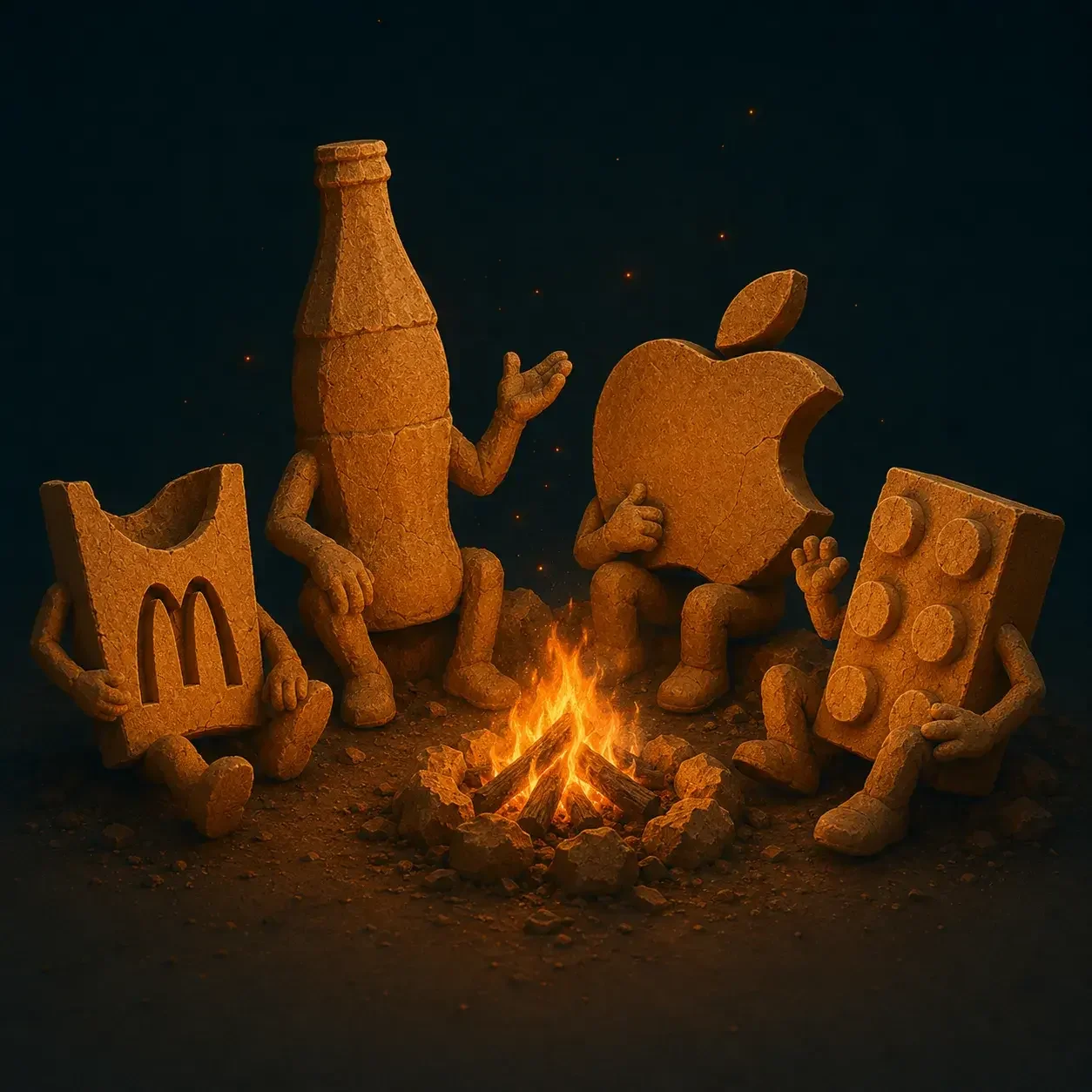
Your brand is not your logo, your colour palette, or your tagline. It is something far more alive than that and the brands that understand this are the ones people genuinely remember, follow, and defend.
Think about the last time a brand made you laugh. Or surprised you. Or made you feel oddly loyal to a chicken restaurant. Chances are, that reaction had very little to do with their font choices and everything to do with their personality.
Brand personality is the human dimension of a brand, the consistent set of traits, values, and behaviours that make a business feel like a recognisable character. It is the reason two brands can have equally polished visual identities and yet one feels alive while the other feels corporate. One earns loyalty; the other earns indifference. The difference is almost always personality or the absence of it.
In fact, the simplest way to understand it is through the lens of personification: brand personality is what happens when you give a company the kinds of qualities we normally associate with people. The way they speak. The things they find funny. The values they stand for. The attitude they carry into every room.
The brands that get it right
A few names come up immediately when you talk about strong brand personalities. Nando's. Ryanair. Apple. Coca-Cola. Red Bull. These are companies that have moved well beyond their product categories and into something closer to cultural membership.
Take Nando's. It is, at its core, a restaurant chain. But its personality is so distinct and so consistently executed that people now wait, genuinely anticipate, their response to major news events. When something significant happens in South African politics, audiences expect Nando's to say something clever and irreverent about it. One early ad said their peri-peri was so hot you'd need to keep your toilet roll in the freezer. That kind of irreverence became the foundation of a brand narrative that grew, over time, into sharp political commentary. People share it. People talk about it. The brand earns attention in moments that have nothing to do with food, which is an extraordinary thing for a restaurant chain to pull off.
Part of why this works so well in the South African context is cultural. As a country that deals with a steady stream of serious, often ludicrous, sometimes infuriating events, South Africans have developed humour as a coping mechanism. Nando's understands this. When a politician does something outrageous and Nando's responds with a sharp, funny ad, it is not just brand awareness, it is cultural resonance. The brand is saying: we see what you see, and we feel the same way about it.
Establishing a resonating brand personality is almost getting your brand to a super saiyan level, it becomes something by itself. People follow you, they're curious about what your brand says about things that happen in the world.
Then there is Ryanair, a budget airline that, on paper, has every reason to keep its head down. Delayed flights, extra baggage fees, tight seats, not exactly the raw material of a beloved brand. And yet their social media presence has become a phenomenon in its own right. They lean into the chaos. They are self-deprecating and occasionally savage. People follow Ryanair not to book flights, but simply to be entertained. Their social presence has become more famous than the product itself, which is a remarkable achievement for a company in one of the most complained-about industries on earth.
Red Bull is another fascinating case study, and perhaps a more counterintuitive one. Go to their social media account and you will notice something strange: they almost never mention their product. No ingredient lists, no energy claims, no benefits. Instead, their account is a stream of cyclists launching off mountains, snowboarders pulling triple backflips, and athletes doing things that seem to defy physics. Red Bull does not sell a drink, they sell a feeling. Extreme. Youthful. Adventurous. The product is almost beside the point. The personality does the selling.
Humour as a strategic choice
There is a pattern worth noticing across many of the most memorable South African brands: they use humour in industries that traditionally relied on the opposite. Nando's pokes fun at politics in a sector that usually plays it safe. Kulula brought jokes to an aviation safety announcement that most passengers had tuned out for years. Naked Insurance disrupted a fear-driven industry with billboards that said things like "Jimmy got naked at the braai", funny, weird, and entirely on brand. The fact that the product is called Naked is itself a brand personality decision. Even the name makes you smile.
What these brands understood is that humour creates talkability. When something is funny, people share it. When it is funny and sharp and culturally specific, it goes viral. And viral content, particularly the earned kind, not the paid kind, is extraordinarily cost-effective. It is guerrilla marketing at its most efficient: cheap to produce, potentially massive in impact.
The key, though, is that humour has to be a conscious, deliberate choice, and once you make it, you need to know exactly how far you can push it. Nando's has been doing this long enough to have a very clear sense of where the line is. They have found their edge and learned to work it without crossing it. That kind of calibration does not happen overnight.
Personality without humour: Apple and the quiet kind of dominance
Not every strong brand personality is built on laughs. Apple is the counter-example, a brand with one of the most powerful personalities in the world, built almost entirely on restraint, quality, and a quietly superior attitude.
Ask an iPhone user why they have an iPhone and not a Samsung or a Huawei, and the honest answer from most of them is simply: "I prefer Apple." Not because of the UX, not because of the specs, not because of the camera, just because of Apple. That "just because" is brand personality working at its most powerful. It has moved beyond rational justification into something closer to identity. Steve Jobs understood this. He famously believed that consumers do not always know what they want but he knew what he wanted to build, and he built it with an almost religious consistency. That consistency became the brand's personality. Premium. Elegant. Quietly superior. And those traits transferred, over time, to the people who use the products.
It is worth noting that this kind of personality is not without risk. Apple users have occasionally revolted when the brand seemed to compromise its own standards, removing ports, changing connectors, launching products that felt below par for the price. The personality is so strong that any deviation from it is noticed and felt. That is both the power and the vulnerability of a well-established brand identity.
Brand personality vs. branding, and why the difference matters
Here is where it is worth drawing a clear line. Branding, in the traditional sense, is your visual identity: your logo, your colours, your typography. These are essential. They create recognition. But they are not your personality. They are, at best, one expression of it.
Coca-Cola understood this decades ago. When they moved into new markets, they did not just put their logo on everything, they brought umbrellas, chairs, lights, refrigerators. Many of these items did not even carry the full logo. They carried brand cues: the red, the contour bottle shape, the warmth. The shape of the Coca-Cola bottle alone became one of the most iconic sub-brands in history. Not a logo. A shape. That is how deep brand personality can go when it is done properly.
Consider South African banking. You probably do not need to see a full logo to know which bank is which. Blue is Standard Bank. Red is ABSA. The grey-teal palette is FNB. Capitec, meanwhile, has done something even more interesting, they have a sonic brand, a brand mnemonic, the little sound that plays every time you tap your card, that is arguably more recognisable than their visual identity. Most people could not describe their logo accurately. But everyone knows the sound. That is a brand element that lives entirely outside the logo, and it works.
A logo is simply a small part of a very much bigger process. There are so many tools at your disposal; tone of voice, colour, product design, sound, community, and all of them build personality.
The building blocks
Brand personality does not come from a single decision. It is assembled, deliberately, from a set of building blocks that, when they align, create something coherent, recognisable, and resilient. These are the core elements:
Core values
Tone of voice
Visual identity
Emotional positioning
Consistency everywhere
Brand story
Signature style and behaviour
Community and culture
Human presence
Repetition over time
Values come first. Always. Think of them the way you think about a person's upbringing, the core of who you are, shaped early, influencing everything that comes after. Without clear values, the rest of the building blocks have nothing to anchor to. The tone of voice, the visual identity, the emotional positioning, they all flow from the values. Get those right, and everything else becomes more coherent.
Emotional positioning is worth singling out. People remember feelings more than products. Wimpy's nostalgic ads… the ones where a child sits with a grandparent at that familiar table , are effective not because they sell food but because they sell a memory. For South Africans who grew up going to Wimpy with their parents or grandparents, those ads hit somewhere deeper than hunger. That is emotional positioning done well.
And then there is human presence, the idea that founders and leaders can themselves be an expression of brand personality. Richard Branson and Virgin. Elon Musk and Tesla. The risk, as Musk has demonstrated, is that when the person goes off-script, becomes divisive, political, unpredictable, the brand absorbs that damage. People were photographed vandalising Teslas. That is a brand personality crisis caused entirely by a human being, not a product failure. The founder-as-brand is a powerful strategy, but it comes with real exposure.
Differentiation as the ultimate goal
Brand personality, at its most practical, is a differentiation tool. Capitec entered a South African banking market dominated by four institutions that all looked, felt, and communicated in remarkably similar ways. They came in with a different set of traits, simplicity and innovation, and built everything around those. Their product promise, their app, their advertising, their branch experience: all of it expressed the same core idea. And it worked. Other banks eventually started chasing the same territory, which is perhaps the most reliable signal that the strategy succeeded.
Naked Insurance did something similar in a market built on fear. Rather than following the industry convention of crash footage and mortality statistics, they used humour, a bold colour palette, and a product name that made people smile to signal something fundamentally different: insurance does not have to be scary or complicated. That choice to go against the grain of an entire industry's communication style is brave. But when it resonates, it does not just build awareness, it builds preference.
That is ultimately what all of this is working toward. A brand with a strong, well-defined personality does not just get noticed. It gets remembered, chosen, and defended. People start identifying with it. They feel ownership of it. They become advocates without being asked. The brand takes on a life beyond the marketing budget and that is when it really starts to do extraordinary things.
Over the next seven weeks, we will look at how all of this plays out in practice: how your brand sounds, how it behaves on social media, how its personality lives in your website and your product, and how to keep it consistent without letting it go stale. We will also look at the brands that got it wrong, because understanding failure is just as valuable as studying success. But it all starts here, with understanding what you are actually building when you build a brand personality.
It is not a logo. It is a character. And characters, when they are good ones, last.
Author’s note
This article reflects the opinions and interpretations of the authors, based on a conversation about brand personality. The examples discussed are used to explore how brand personality can be understood in practice, rather than to present definitive facts about the brands mentioned.